Chess Board Setup
White on 1–2, Black on 7–8. Queen on her own colour.
Tap a piece, then tap a square. Drag and drop works too.
How to set up a chess board
Learning how to set up a chess board comes down to four simple steps. Follow them from the outside corners inward to set it up in under a minute, and you will have the standard chess board layout ready for any casual or tournament game. Before you begin, sort the pieces into two piles of 16 – eight pawns, two rooks, two knights, two bishops, one queen and one king for each colour.
- Turn the board the right way. Sit facing your opponent and check the corner square nearest your right hand. Both players must see a light square there – “light on the right”. For White that corner is h1; for Black it is a8. If your board has printed coordinates, ranks 1 and 2 belong to White and ranks 7 and 8 belong to Black.
- Build the back rank from the corners inward. Working from outside in prevents swaps: place the two rooks on the corner squares (a1 and h1 for White; a8 and h8 for Black), the knights right next to them (b1/g1 and b8/g8), and the bishops beside the knights (c1/f1 and c8/f8). Only the two central squares, files d and e, remain open.
- Put the queen on her own colour, then place the king. Look at the two open centre squares: the white queen goes on the light square d1, and the black queen goes on the dark square d8. Drop each king onto the final empty square beside her (e1 for White, e8 for Black) so every piece on rank 1 stands directly across from its twin on rank 8.
- Line up the eight pawns in front. Fill rank 2 (a2 through h2) with the eight white pawns and rank 7 (a7 through h7) with the eight black pawns. Ranks 3, 4, 5 and 6 stay completely empty, completing the standard chess board setup of 32 pieces.
Quick reference: White’s view (a1 to h1)
Sitting behind the white pieces, files run from a on your left to h on your right. Notice how rank 1 and rank 8 have opposite square colours on every file, which is why both queens share the d-file while standing on their own colour.
| White square | Black square | Piece |
|---|---|---|
| a1 (dark) | a8 (light) | Rook |
| b1 (light) | b8 (dark) | Knight |
| c1 (dark) | c8 (light) | Bishop |
| d1 (light) | d8 (dark) | Queen – Matches her own colour (d1 light, d8 dark) |
| e1 (dark) | e8 (light) | King |
| f1 (light) | f8 (dark) | Bishop |
| g1 (dark) | g8 (light) | Knight |
| h1 (light) | h8 (dark) | Rook – h1 is White’s bottom-right light corner |
Pawns: a2–h2 for White, a7–h7 for Black. Ranks 3 to 6 start empty.
Setting up from Black’s side (diagram & left-to-right table)
Checking a chess board setup from Black's side trips up many beginners because almost every textbook diagram is drawn from White's seat. From Black's chair, file h is on your far left and file a is on your far right. Because of that 180° view, your king on e8 sits to the left of your queen on d8, even though neither piece has changed squares: e8 still faces White's king on e1, d8 is still a dark square for the black queen, and a8 is still the light square in your right-hand corner.
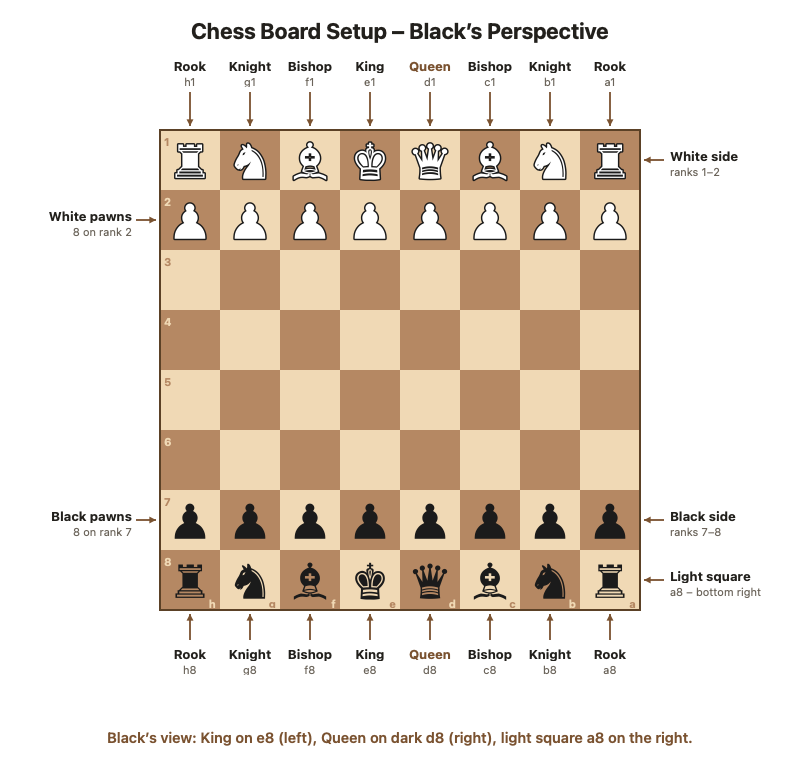
| From Black’s left | Square | Square colour | Piece |
|---|---|---|---|
| 1st (far left) | h8 | Dark | Rook |
| 2nd | g8 | Light | Knight |
| 3rd | f8 | Dark | Bishop |
| 4th (centre-left) | e8 | Light | King – Appears to the left of the queen from Black’s chair |
| 5th (centre-right) | d8 | Dark | Queen – Black queen on a dark square, facing White’s queen on d1 |
| 6th | c8 | Light | Bishop |
| 7th | b8 | Dark | Knight |
| 8th (far right) | a8 | Light | Rook – Bottom-right light corner from Black’s side |
What to play after setting up: White’s first move
Once your chess board setup is complete with all 32 pieces in the starting position, White always moves first (to choose colours fairly, one player hides a white pawn in one fist and a black pawn in the other, lets the opponent pick a hand, and then the two players alternate colours in the next game). On turn one, only pawns and knights can legally move – pawns one or two squares straight ahead, and knights jumping to a3, c3, f3 or h3 – giving White 20 legal options, though nearly every game begins with one of these four openings:
1. e4(King’s Pawn Opening): Advances the pawn in front of the king two squares to claim central space immediately and open diagonals for both the white queen and the light-squared bishop.1. d4(Queen’s Pawn Opening): Pushes the queen’s pawn two squares into the centre where it is already defended by the queen on d1, freeing the dark-squared bishop and steering play into solid strategic lines.1. Nf3(Réti Opening): Develops the kingside knight toward the centre to control d4 and e5 without committing a central pawn on turn one, leaving kingside castling only two moves away.1. c4(English Opening): Fights for the central d5 square from the flank rather than head-on, keeping the e- and d-pawns flexible while inviting asymmetrical positions.
Black then answers on move one – classically mirroring the centre with 1...e5 or 1...d5, or contesting it asymmetrically with 1...c5 (the Sicilian Defence) or 1...Nf6.
Chess board setup with names
The diagram below shows the full chess board setup with names for every piece in the starting position. Each player begins with one king, one queen, two rooks, two bishops, two knights and eight pawns.
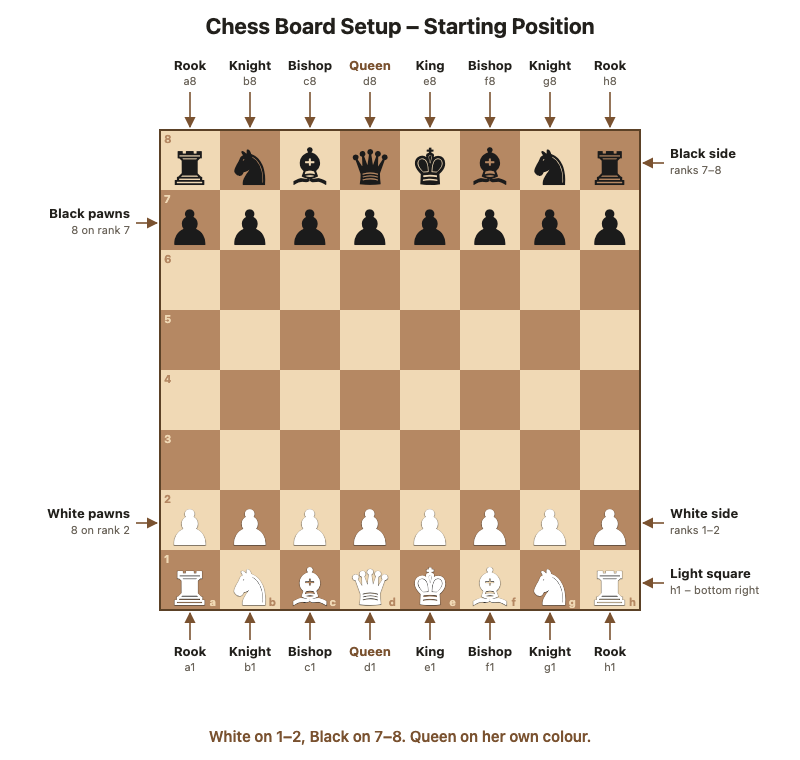
Not sure which physical piece is which? The king is the tallest piece on the board and carries a cross on top; the queen is second tallest and wears a multi-pointed coronet; the bishop has a rounded mitre with a diagonal slit; the knight is carved as a horse’s head; the rook looks like a castle tower; and the eight pawns are the shortest pieces with smooth round tops.
Common mistakes
Four errors cause almost every wrong chess board setup when players set it up from memory. Check the board before the first move.
What happens if the chess board is set up the wrong way round?
The most common chess board setup mistake is turning the board 90°, so a dark square ends up in your right-hand corner. Before placing any pieces, check the corner nearest your right hand: it must be a light square (h1 for White, a8 for Black). If it is dark, give the board a quarter turn and start again.
Does the queen go on d1 or e1? (king and queen swapped)
The queen goes on d1 for White and d8 for Black; the kings go on e1 and e8. Remember “queen on her own colour”: the white queen stands on a light square and the black queen on a dark square. When your chess board setup is right, the two queens face each other along the d-file and the two kings face each other on the e-file.
How do I set up the chess board from Black's side?
From Black's side the back rank reads h8 to a8 from left to right, so the black king (e8) appears to the left of the black queen (d8). Nothing about the rules changes: keep a light square (a8) in your bottom-right corner and put the black queen on her own dark colour (d8). Switch to the Black's view tab on the interactive board above or check the Black's-side diagram to verify every square.
How many pawns does each side need?
Each player starts with exactly eight pawns, one on every file of rank 2 (White) and rank 7 (Black), making 16 pieces per side and 32 in total. If you only count seven pawns, check the box or table before starting, because an open file from move one gives a rook an immediate highway.
More chess basics
- Chess pieces namesComing soonChess pieces names, symbols and how each piece moves
- Chess piece valuesComing soonHow many points a pawn, knight, bishop, rook and queen are worth
- RulesComing soonChess rules for beginners: check, checkmate, castling and en passant
- NotationComing soonHow to read and write chess notation like e4, Nf3 and O-O
- Printable boardComing soonFree printable chess board and starting position diagram
- EditorComing soonChess board editor to build any position and export FEN